
Healthy Employees Create Healthy Companies: Why Mental Health Belongs at the Center of Workplace Culture
We talk about culture, performance, and productivity but there is one thing sitting underneath all of it: the mental health of your employees...
We talk a lot about company culture. We talk about performance. We talk about productivity. We talk about retention, leadership, innovation, and growth.
But there is one thing sitting underneath all of it: the mental health and well-being of your employees.
A company cannot build a truly healthy culture if the people inside of it are overwhelmed, burned out, disconnected, afraid to speak up, or struggling in silence.
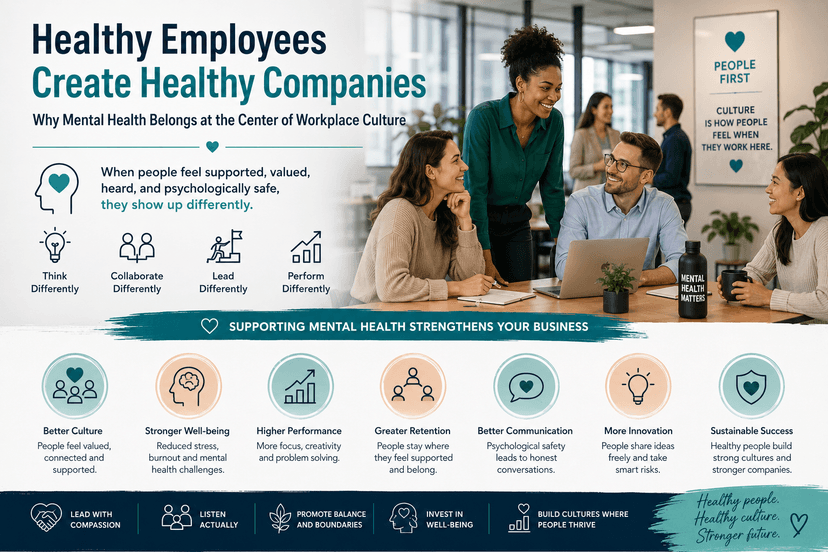
Your employees are not machines. They are human beings. And when people feel supported, valued, heard, and psychologically safe, they show up differently. They think differently. They collaborate differently. They lead differently. And ultimately, the company performs differently.
Mental Health Is a Business Issue
For years, workplace mental health was treated like a personal issue something employees were expected to deal with on their own. But stress does not magically disappear when someone logs into work. Anxiety does not stay outside the office. Grief does not wait until the weekend.
Family challenges, financial pressure, caregiving responsibilities, health concerns, burnout, and uncertainty all come to work with us. That does not mean companies are responsible for solving every problem in an employee's life. It does mean leaders have a responsibility to create an environment where people can work without sacrificing their well-being.
Because when employees are mentally exhausted, the effects show up everywhere: absenteeism, presenteeism, low engagement, poor communication, turnover, conflict, reduced creativity, and eventually, burnout. Supporting mental health is not separate from the business. It is part of building a stronger business.
Culture Is Not What You Put on the Wall
Companies love words like integrity, innovation, compassion, excellence, and people first. But culture is not the slogan hanging in the lobby. Culture is how people feel when they work there.
Do employees feel safe telling their manager they are overwhelmed? Can someone ask for help without fearing judgment? Do leaders actually take vacations, or do they promote burnout by example? Are people recognized only for results, or also for collaboration, growth, and healthy leadership? Do employees feel connected to one another? Those are culture questions and mental health touches every one of them.
Psychological Safety Changes Everything
One of the most powerful things a company can create is psychological safety that means employees feel they can speak honestly, ask questions, share ideas, admit mistakes, and raise concerns without fear of humiliation or retaliation.
When that exists, people innovate more freely. Teams communicate earlier when something is wrong. Managers hear about problems before they become disasters. Employees contribute ideas they might otherwise keep to themselves. And people feel like they belong. A healthy workplace does not mean everyone agrees all the time it means people can disagree, learn, and grow without feeling personally threatened.
Burnout Should Not Be a Badge of Honor
We have normalized exhaustion for too long back-to-back meetings, late-night emails, working through vacations, being available every hour of the day. We sometimes celebrate these things as commitment, but chronic exhaustion is not a sign of a high-performance culture. It can be a warning sign of an unhealthy one.
There is a major difference between working hard during an important season and building an environment where overwork becomes the expectation. Strong leaders understand that sustainable performance requires recovery. People need boundaries. People need rest. People need flexibility. And sometimes people simply need permission to say: "I need help."
Managers Matter More Than We Realize
An employee's experience of a company is often shaped largely by their direct manager. That is why companies cannot talk about mental health without talking about leadership development.
Managers do not need to become therapists. They do need to learn how to lead human beings that means knowing how to listen, how to recognize when someone's behavior has significantly changed, how to have compassionate conversations, how to direct employees toward available resources, how to set reasonable expectations, and how to create trust. Sometimes one thoughtful conversation from a manager can completely change how an employee feels about their workplace.
Connection Builds Resilience
One of the greatest protections against workplace isolation is community. Employees need opportunities to connect beyond transactions and deadlines through employee resource groups, mentorship, peer communities, team check-ins, wellness groups, leadership circles, volunteer opportunities, and shared challenges.
These things can create something powerful: belonging. When employees feel like they belong, they are not simply working for a company they feel connected to the people inside of it. And connection can make organizations much more resilient during difficult periods.
Mental Health Support Has to Go Beyond an EAP
Offering an employee assistance program can be valuable, but if nobody knows it exists, feels comfortable using it, or can easily access it, it is not enough. Mental health should be woven into the employee experience through education, coaching, digital mental wellness tools, stress-management resources, support communities, manager training, flexible work practices, and easier pathways to professional care.
The goal should not simply be "we have a benefit." The better question is: "Are our people actually using the support, and is it helping them?" That is a very different mindset.
Leadership Sets the Tone
Employees watch what leaders do far more than what leaders say. If a CEO talks about wellness but sends emails at midnight expecting immediate responses, employees notice. If managers say, "take care of yourself," but punish people for taking time off, employees notice.
If senior leaders openly talk about stress, boundaries, therapy, coaching, exercise, family responsibilities, or taking a mental health day when needed, that sends a different message: you are allowed to be human here. That kind of leadership helps remove stigma.
Healthy People Help Build Healthy Companies
There will always be deadlines, pressure, and ambitious goals. Supporting mental health does not mean lowering standards. It means creating the conditions that help people meet those standards without destroying themselves in the process.
You can have accountability and compassion. You can have high performance and humanity. You can push for results and still care about the person producing them. In fact, those things should go together.
Ask Your Employees One Simple Question
Leaders spend enormous amounts of money studying employees through surveys, dashboards, consultants, performance reviews, and analytics. But sometimes the most powerful thing a leader can do is ask: "How are you really doing?" And then actually listen to the answer.
Your employees will tell you what your culture feels like. They will tell you where the stress is. They will tell you what they need. The question is whether leadership is willing to hear it.
The Future of Work Must Be Human
Technology will continue changing how we work. AI will automate more tasks. Organizations will become faster. Workplaces will become increasingly digital. But as technology becomes more powerful, something else becomes even more important: our humanity.
People want to know that they matter. They want purpose. They want connection. They want to be heard. They want to work somewhere that recognizes that success should not require sacrificing their mental health.
The companies that understand this will not simply create better wellness programs. They will create stronger cultures. They will attract better talent. They will develop better leaders. And they will build organizations where people genuinely want to stay and grow.
Because at the end of the day: healthy employees help create healthy cultures. Healthy cultures create stronger companies. And companies that take care of their people create the foundation for sustainable success.
Mental health is not just an employee benefit. It is a leadership priority. It is a culture priority. And it is a business priority.